This post is also available in:
I read in a book by Joe Friel that most hobby athletes train harder than professionals. That stuck with me. Could that be true? Does that apply to cyclists as well? I wanted to take a closer look at the study. What exactly did that bold statement mean?
Polarized Training
I asked the AI and found the “Polarized Training Model” developed by sports scientist Dr. Stephen Seiler. His main point is that hobby athletes often train at a significantly higher intensity than professional athletes. Professionals hold themselves back, while amateurs tend to train at full throttle all the time.
A scientific analysis of professional athletes revealed that they spend about 80–85% of their training in Zone 1. They dedicate only about 15–20% of their training to high-intensity intervals in Zone 3. Zone 2, which lies between the two, is virtually never used by professional athletes.
Hobby athletes, on the other hand, take a different approach. They want to get the most out of every training session. “No pain, no gain” is their motto. They often spend up to 60–70% of their time in Zone 2 or 3. They train so hard that they’re exhausted after every session. As a result, they’re too tired for the actual high-intensity intervals. Thus, many hobby athletes train constantly and ineffectively in the middle, or “gray zone.”
Implementation
The training approach known as “polarized training” was included right from the start. Up until then, I had strictly rejected any kind of training plan. I wouldn’t win any races even with structured training. But this principle is very simple and easy to implement without having to create and elaborate training plans.
For me, this means I’ll do two rides per week with strict pacing in Zone 1. This includes my longer weekend ride. I’ll incorporate maximum intensity training with intervals into only one session. However, I won’t follow strict time guidelines for this; instead, I’ll adapt it to the route.
| Zone | Intensity | Road Bike Training |
|---|---|---|
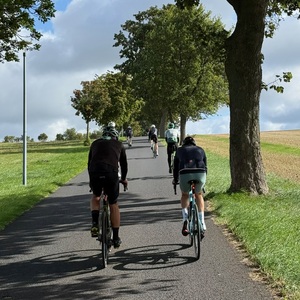
| Zone 1 (easy) | below 75% | Main zone (80 % of the trips). These are the long, relaxed endurance rides. When going uphill, you often have to consciously shift down a gear and ease off the pedals to stay in the zone. |
| Zone 2 (intermediate Area) | 75% to 85% | The Grey Zone (Avoid!). That’s the typical pace at which recreational cyclists ride almost every ride. It feels brisk and athletic, but it offers little physiological benefit and leaves you too exhausted for the tough days ahead. |
| Zone 3 (hard) | above 85% | Intervall Zone (20 % of the units). You’ll do this on steep hills or during targeted intervals (e.g., 4 x 4 minutes or 4 x 8 minutes at full speed). Here, you can—and should—really push yourself to the limit. |
The Theory Behind It
The body has two different types of energy systems: aerobic and anaerobic. To get faster on the bike, you need two things:
- More “mitochondria” (the cells’ powerhouses for endurance) and
- a greater “stroke volume” so that more oxygen is transported to the muscles
Endurance training (Zone 1) makes the foundation. During this phase, the number of mitochondria increases, leading to more efficient fat burning. However, beyond a certain point, they no longer increase the size of the heart.
The Turbo Engine (Zone 3): Those intense minutes provide the thrill that long rides simply can’t match. The extremely high pressure forces the heart to work at maximum capacity. It adapts by enlarging and pumping more blood with each beat.
Studies show that the body needs only a very small but extremely precise stimulus to trigger the “turbo response.”
Diminishing Benefit
With one intense workout per week, you can achieve about 80% of your maximum possible progress. Another intense workout would likely result in only about 5% more progress – but at the cost of a high risk of overexertion.
How has it been so far?
If hobby cyclists accelerate a little on every ride and ride in Zone 2, the intensity is too high for true base training. Fat burning isn’t improved and remains poor. But for true cardiovascular training, the ride is too slow. You’re riding in a sort of athletic limbo.
Different from now on
Only when the long rides are truly easy will the cellular energy be available on high-intensity days to sustain the intensity needed to shock the system and force it to adapt.
Give it a try
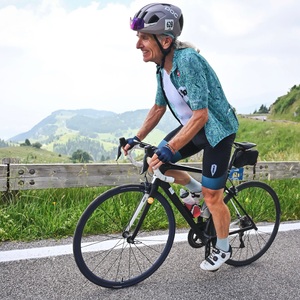
That sounds reasonable to me. Reasonable enough to give it a try. I’ll test it out for 6–8 weeks, riding at a relaxed pace twice a week and including just one intense interval session per workout.
As a result, I should be able to pedal at significantly higher wattage levels while maintaining the same low heart rate. I am curious to see if it works out.